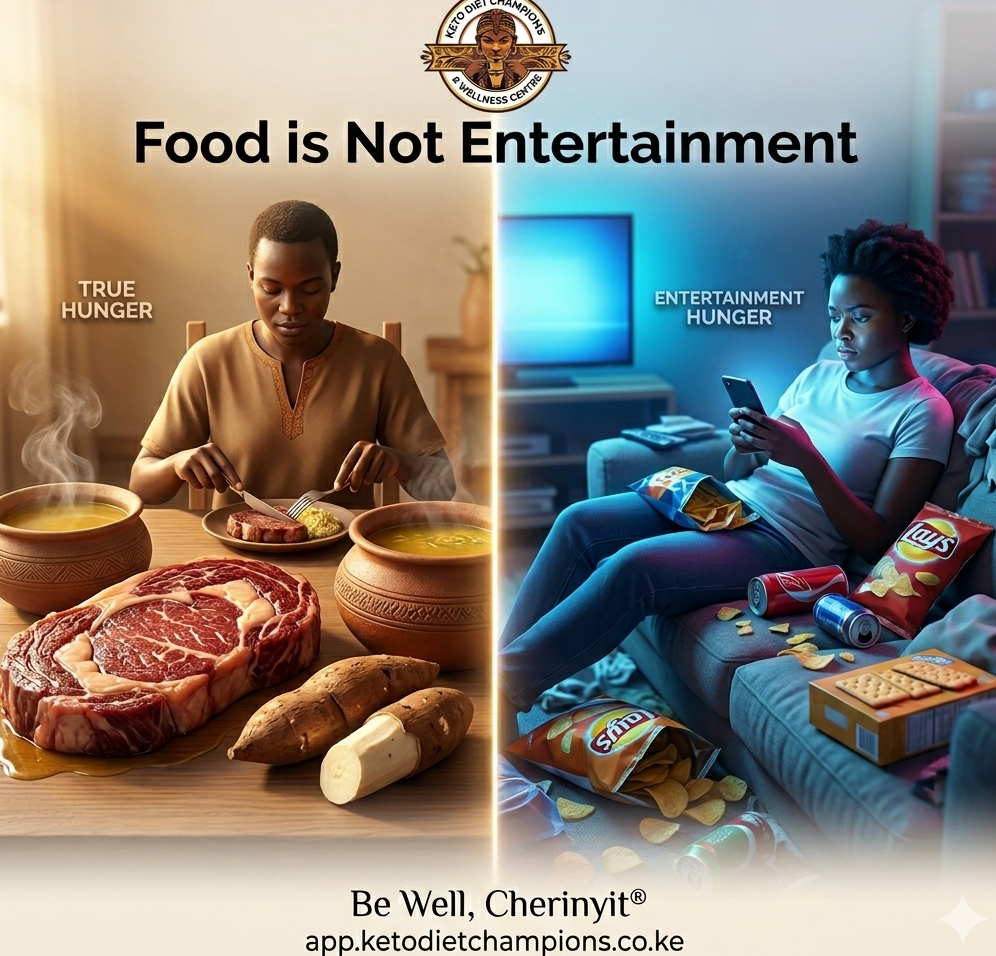
Food is not Entertainment
True hunger is unmistakable: gradual onset, satisfied by any nutritious food, accompanied by a slight energy dip, and completely satisfied by appropriate portions. Stop entertaining yourself with food. Start nourishing yourself with intention.
Korir Cherinyit
Monday, 15 June 2026
Food is not Entertainment
By Cherinyit | 15 Jun, 26 |
True hunger is unmistakable: gradual onset, satisfied by any nutritious food, accompanied by slight energy dip, and completely satisfied by appropriate portions.
I always say to listen to our bodies and practice mindful eating and intuitive eating. What does that mean?
While you convince yourself you need that third snack of the afternoon, your brain is desperately seeking stimulation that food was never designed to provide. People consume 73% more food than physiologically required, according to research from the USDA Economic Research Service, and entertainment eating is the primary driver.
But here's the neuroscientific truth the food industry hopes you never discover: every time you eat for entertainment rather than genuine hunger, you're literally rewiring your brain's appetite control system. You're teaching your neural pathways to confuse boredom with hunger, pleasure-seeking with nourishment, and stimulation with satiation.
The global food industry generates $2.1 trillion annually by deliberately designing products that bypass your natural satiety signals. These aren't just "tasty foods" — they're neurologically engineered entertainment devices disguised as nutrition.
Dr. Ashley Gearhardt's research at the University of Michigan found that 92% of processed foods are specifically formulated to trigger dopamine responses similar to addictive substances. The food industry employs teams of neuroscientists, flavor chemists, and behavioral psychologists whose sole job is creating products that you literally cannot stop eating.
The Bliss Point Formula:
When you eat for entertainment, your brain releases dopamine — the same neurotransmitter involved in gambling, social media scrolling, and substance addiction. Research from Yale School of Medicine using fMRI brain scans revealed that people eating while distracted show 340% higher dopamine activity in reward centers compared to focused eating.
This dopamine flood has devastating consequences for appetite regulation:
Leptin Resistance Development: Your satiety hormone leptin becomes less effective when dopamine pathways are overstimulated. Studies from Rockefeller University show that chronic entertainment eating reduces leptin sensitivity by 60%, meaning your brain never receives the "I'm full" signal.
Ghrelin Dysregulation: Your hunger hormone ghrelin begins triggering not just from empty stomach signals, but from environmental cues associated with entertainment — Netflix opening, phone notifications, even specific times of day. Research from the University of Southern California found that entertainment eaters produce 85% more ghrelin when exposed to food-associated entertainment cues.
Prefrontal Cortex Suppression: The brain region responsible for decision-making and impulse control becomes less active during entertainment eating. Neuroimaging studies from Harvard Medical School demonstrate that distracted eating reduces prefrontal cortex activity by 45%, essentially putting your conscious mind on autopilot while your reward system takes control.
The Hidden Mechanism: How Entertainment Hijacks Satiety
Your body has sophisticated mechanisms designed to regulate food intake automatically. These systems evolved over millions of years to maintain optimal body composition without conscious effort. Entertainment eating systematically dismantles every one of these natural controls.
The Satiety Cascade Breakdown:
Visual Satiety Disruption: When you eat while watching screens or reading, your brain doesn't fully register the visual cues of food consumption. Studies from the University of Oxford found that people eating while distracted consume 25% more food and report feeling less satisfied afterward.
Mechanical Satiety Bypass: Entertainment eating typically involves foods that require minimal chewing — chips, crackers, soft textures that dissolve quickly. Research from Wageningen University shows that adequate chewing time is responsible for 40% of satiety signaling. When you skip this mechanical process, your brain misses crucial fullness cues.
Gastric Stretch Receptor Confusion: Your stomach has stretch receptors that signal fullness, but entertainment eating often involves continuous small portions that never trigger these receptors adequately. Meanwhile, the dopamine response tricks your brain into thinking you need more stimulation, overriding mechanical fullness signals.
The Warning Signs Your Appetite Is Hijacked
Stop and honestly assess these behavioral patterns that indicate entertainment eating has compromised your natural appetite regulation:
Psychological Indicators:
Physical Indicators:
Social/Behavioral Indicators:
If you recognize four or more of these patterns, entertainment eating has likely disrupted your natural appetite control mechanisms.
The Protocol: Reclaiming Natural Satiety
Restoring natural appetite regulation isn't about more restriction — it's about retraining your brain to recognize and respond to genuine physiological hunger and satiety signals.
Phase 1: Dopamine Reset (Weeks 1-2)
Complete Entertainment Eating Elimination:
Mindful Consumption Protocol:
Phase 2: Hunger Recognition Training (Weeks 3-6)
True Hunger Identification: Physical hunger manifests as stomach contractions, slight energy dip, and clear desire for any nutritious food. Entertainment cravings target specific foods (usually processed) and occur regardless of recent eating.
The Hunger Test: Before eating, ask: "Would I be satisfied with plain chicken breast and vegetables right now?" If the answer is no, you're likely seeking entertainment, not nutrition.
Satiety Signal Restoration:
Phase 3: Natural Regulation (Weeks 7-12)
Environmental Design:
If you continue entertainment eating:
If you restore natural eating patterns:
The University of California San Francisco's longitudinal study following 5,000 participants found that those who eliminated entertainment eating maintained stable weights 94% more successfully than those who continued distracted consumption patterns.
The Shocking Truth About Satisfaction vs Satiation
The food industry has cleverly confused two completely different biological processes: satisfaction (psychological pleasure) and satiation (physiological fullness).
Satisfaction is temporary, dopamine-driven, and never truly fulfilled by food. You can eat an entire bag of chips and feel satisfied momentarily, but you'll want more within hours because psychological satisfaction doesn't trigger lasting satiety hormones.
Satiation is biological fullness triggered by adequate protein, proper nutrient density, and mechanical stomach signals. When you eat for satiation rather than satisfaction, your appetite naturally regulates for 4–6 hours without conscious effort.
Dr. Barbara Rolls' research at Penn State University demonstrated that people eating for satiation (protein-rich, nutrient-dense meals) consumed 38% fewer total calories throughout the day compared to those eating for satisfaction (processed, entertainment foods).
Breaking Free From the Entertainment Eating Trap
The path forward requires rewiring your relationship with food from entertainment device back to biological fuel. This isn't about restriction — it's about restoration of natural appetite control that makes conscious restriction unnecessary.
Traditional Approach: "I'll use willpower to stop emotional eating while still treating food as my primary source of pleasure and stress relief."
Satiation-Based Approach: "I'll redesign my environment and eating patterns to support natural appetite regulation while developing non-food sources of entertainment and emotional regulation."
Research from the Mayo Clinic's Behavioral Medicine Program found that environmental redesign was 340% more effective than willpower-based approaches for eliminating entertainment eating patterns.
The Science of Natural Appetite Control
Long-term appetite regulation isn't about fighting cravings — it's about creating conditions where natural satiety signals function properly.
The Framingham Heart Study, following 12,000 individuals for 30 years, identified consistent behaviors among people who maintained stable weights without conscious restriction:
Biological Satiety Support:
Environmental Design:
None of these successful individuals used willpower to control appetite. They created conditions where natural appetite regulation could function normally.
The Hidden Cost of Food Entertainment
Entertainment eating doesn't just affect your waistline — it systematically dismantles your body's ability to self-regulate, creating a dependence on external controls that should be unnecessary for a healthy human being.
Neurological Consequences: Research from the University of Michigan found that chronic entertainment eating reduces gray matter in brain regions responsible for impulse control and decision-making. Participants who engaged in entertainment eating for six months showed measurable changes in brain structure similar to those seen in substance addiction.
Metabolic Disruption: When you eat without attention to satiety signals, your body stops producing adequate amounts of cholecystokinin (CCK), the hormone responsible for meal termination. Studies from the University of Washington demonstrate that distracted eaters produce 45% less CCK than mindful eaters, explaining why entertainment eating never feels truly satisfying.
Social and Emotional Costs: Entertainment eating isolates you from natural social eating patterns and genuine emotional processing. Research from Harvard's Department of Social Medicine found that people who eat primarily for entertainment report 60% higher rates of loneliness and have difficulty forming meaningful relationships with food and people.
The Satiation Solution: Eating for Biological Purpose
The alternative to entertainment eating isn't joyless restriction — it's eating that actually satisfies your biological needs so completely that entertainment becomes unnecessary.
Protein-Centered Satiation: Dr. Heather Leidy's research at Purdue University demonstrated that meals containing 30g+ protein increase satiety hormones by 200% and reduce subsequent food intake by an average of 400 calories without conscious restriction.
Nutrient Density Focus: Foods high in nutrients per calorie naturally trigger satiety faster than processed alternatives. Yale's Prevention Research Center found that people eating nutrient-dense foods felt satisfied on 35% fewer calories than those eating processed equivalents.
Mindful Consumption Training: Mindfulness-based eating programs show remarkable success rates. The University of California San Francisco's Center for Obesity Assessment found that 70% of participants eliminated binge eating within eight weeks using mindfulness techniques alone.
THE TRUTH ABOUT MODERN HUNGER: FIVE TYPES YOU MUST DISTINGUISH
Modern humans rarely experience true physiological hunger. Instead, we experience five distinct types of hunger — and confusing them is the primary driver of overeating, weight gain, and metabolic dysfunction.
1. TRUE PHYSIOLOGICAL HUNGER (The Only Real Hunger)
2. SCHEDULED HUNGER (Eating Because It's "Time")
3. SOCIAL HUNGER (Eating Because Others Are Eating)
4. EMOTIONAL HUNGER (Eating to Manage Feelings)
5. ENTERTAINMENT HUNGER (Eating for Stimulation)
6. CONVENIENCE HUNGER (Eating Because Food Is Available)
CRITICAL DISTINCTION: True Hunger vs. All Other Types
| True Physiological Hunger | All Other "Hunger" Types |
|---|---|
| Gradual onset | Sudden, triggered by external cues |
| Stomach contractions, energy dip | No physical signs |
| Satisfied by ANY nutritious food | Demands specific processed foods |
| Completely satisfied after eating | Never truly satisfied; keep eating |
| Occurs 4–6 hours after meal | Occurs anytime, regardless of recent eating |
| No emotional component | Driven by boredom, stress, social pressure, screens |
Why This Matters:
When you confuse entertainment, emotional, or social hunger with true physiological hunger, you:
The Fix:
Before every eating occasion, ask:
True hunger is unmistakable: gradual onset, satisfied by any nutritious food, accompanied by slight energy dip, and completely satisfied by appropriate portions.
Your Metabolic Future Without Entertainment Eating
Every meal you eat for entertainment rather than nourishment trains your brain to ignore natural appetite regulation. Every snack consumed while distracted reinforces the neural pathways that confuse stimulation with satisfaction.
The research demonstrates that appetite regulation can be restored at any age through consistent application of mindful eating principles. Dr. Jon Kabat-Zinn's work at the University of Massachusetts Medical School shows that mindfulness-based interventions restore natural eating patterns in 85% of participants within 12 weeks.
Your hunger signals aren't broken — they're just being drowned out by artificial stimulation. When you remove the entertainment component from eating, your body's sophisticated appetite control system can function as designed.
The choice is straightforward: continue using food as entertainment and remain trapped in cycles of artificial hunger and unsatisfying consumption, or restore your natural relationship with food and discover what it feels like when your appetite regulates itself.
Your body has been trying to tell you when it needs fuel and when it's satisfied. It's time to start listening.
Stop entertaining yourself with food.
Start nourishing yourself with intention.
Your appetite has been waiting patiently for you to remember the difference.
Practical Insight from Hundreds of Clients
As a wellness coach, I've heard the same worry hundreds of times: "I eat a lot — how will I manage?" The reality is simpler than most expect. In the first two days of eliminating entertainment eating and practicing mindful consumption, most clients report something remarkable: no more hunger. The constant urge to snack disappears. By day three, they're eating smaller portions naturally. Within one to two weeks, their cravings normalize and portion size stabilizes without conscious restriction or hunger. The body remembers how to regulate when you stop training it to seek stimulation from food.
Start with these simple actions today:
Be Well,
Cherinyit®
Ancestral Healing & Ketogenic Diet Practitioner
Keto Diet Champions & Wellness Centre
Ready to Start?
Book a consultation today
Take the first step toward your health transformation with a KSh 300 consultation.
Book Now →