Kenyan Mama’s Ancestral-Keto Triumph: Perimenopause and Menopause Mastery
A science-backed, empathetic guide for Kenyan women navigating perimenopause and menopause through an ancestral-keto approach. Learn how food, protein, strength training, sleep, stress control, and root-cause healing can help support hormonal balance, preserve muscle and bone, reduce symptoms, and restore vitality at Keto Diet Champions & Wellness Centre.
Korir Cherinyit
Friday, 15 May 2026
Kenyan Mama's Ancestral-Keto Triumph: Perimenopause to Menopause Mastery
Perimenopause Relief Kenya | Ancestral Keto Menopause | Natural Menopause Solutions Eldoret | Keto Diet Perimenopause Symptoms
By Cherinyit, Founder & Director, Keto Diet Champions & Wellness Centre, Eldoret, Kenya
Sister, picture Wanjiku—our 52-year-old Eldoret Keto Champion, shamba-strong from daily walks to harvest fresh managu, yet ambushed by night sweats soaking her dera, brain fog thicker than Nairobi matatu traffic, knees creaking on stairs, and midsection weight no amount of ugali controlled. Clinics dismissed her: “Ni umri tu” (just age), prescribing more wholegrains, less nyama, unasked antidepressants, and endless cardio. Sound like your story, mama? You're not failing—the advice is. For 40 years, it has ignored menopause as a real metabolic transition, not “wahenga nerves.”
Interestingly, many of our clients who joined Keto Diet Champions & Wellness Centre for other health concerns began noticing improvements in symptoms they had quietly accepted as part of aging, especially hot flashes, mood swings, and night sweats. Some had believed these discomforts were inevitable at their age, but their progress challenged that assumption. Their outcomes became one of the key reasons I researched further and developed a more structured, root-cause program for supporting women through perimenopause and menopause.
Our grandmothers thrived through this on nutrient-dense animal fats, wild greens, and village resilience—no processed sodas spiking insulin or imported fear of sacred meats. At Keto Diet Champions & Wellness Centre, many local mamas—teachers, market vendors, professionals, and hardworking mothers—have transformed chaos into strength. Our ancestral-keto framework, built around animal-based nutrition, high healthy fat intake, and low processed carbohydrates, is designed to support the body at the root level. This is not decline; it is your biology asking to be fed, supported, and restored. Join us at Keto Diet Champions & Wellness Centre to liberate your health.
Perimenopause and Menopause in Kenyan Women
Your reproductive journey spans fertility years, the menopausal transition, and post-menopausal life.
Estrogen is not only a reproductive hormone. It influences insulin sensitivity, inflammation, fat distribution, mitochondrial energy, muscle maintenance, bone density, vaginal lubrication, sleep, and mood. Progesterone has calming effects and supports sleep, while testosterone supports libido, muscle, and bone. When these hormones shift, the body can feel like it is losing its footing all at once.
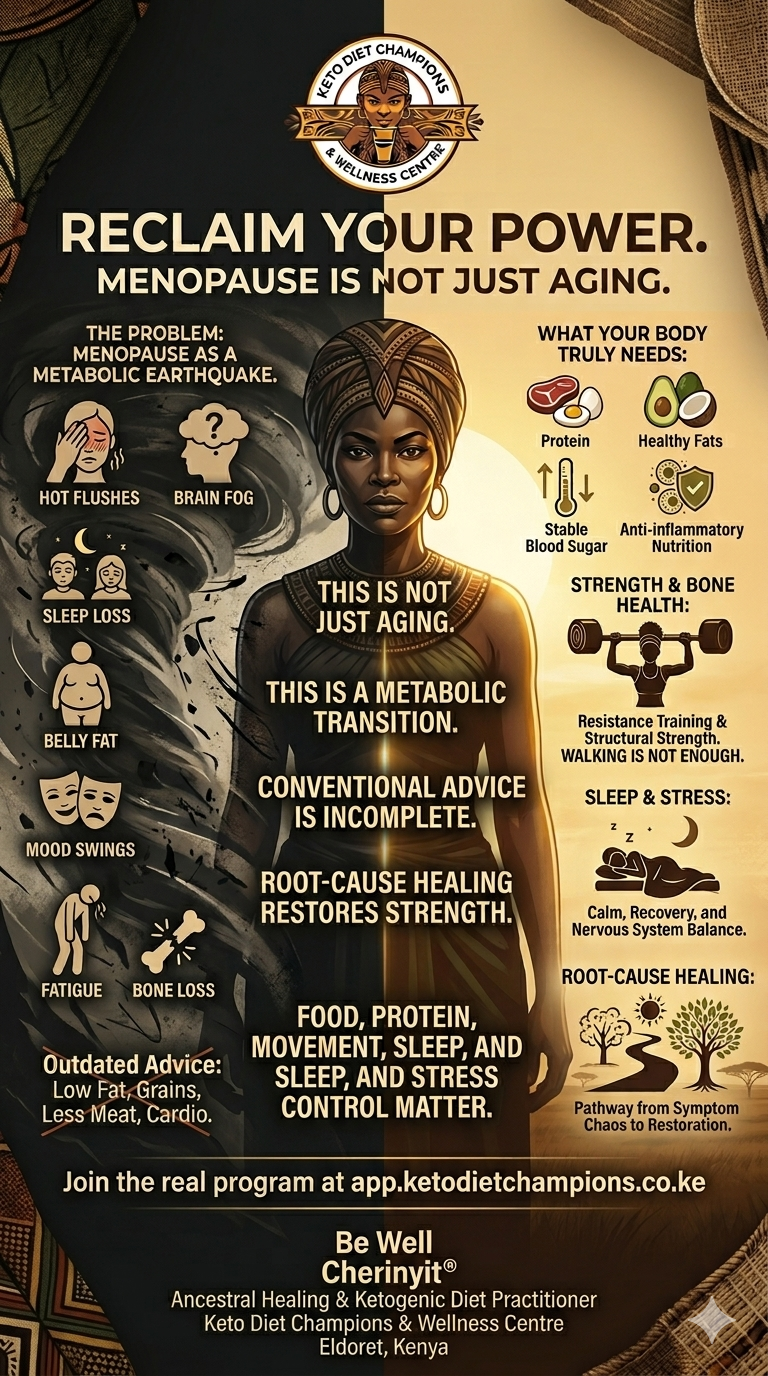
Why Menopause Feels Like a Metabolic Earthquake
The experience of menopause is often more than a hormonal change. It is a full-body metabolic shift.
As estrogen declines, insulin sensitivity often drops, and the body becomes more likely to store fat around the waist. Cortisol may rise because of stress and poor sleep, making belly fat even more stubborn. Muscle mass may begin to decline faster, which weakens metabolism and makes weight control harder. Bone loss also accelerates, increasing the risk of osteoporosis and fracture.
This is why many women suddenly feel as though the body they once knew has changed overnight. The truth is that the body is adapting to a new hormonal reality, and it needs new support.
The Full Symptom Storm
The symptoms of perimenopause vary from one woman to another, but the most common ones include:
| Symptom area | Common signs | Underlying shift |
|---|---|---|
| Cycle changes | Shorter, longer, heavier, or skipped periods | Estrogen and progesterone imbalance |
| Hot flushes | Sudden heat in the face and chest | Thermoregulation changes, inflammation, cortisol shifts |
| Night sweats | Waking soaked at night | Hormonal fluctuation, sleep disruption |
| Sleep problems | Trouble falling asleep, frequent waking | Lower progesterone and estrogen |
| Brain fog | Poor focus, forgetfulness, mental fatigue | Fuel metabolism changes, sleep loss |
| Vaginal dryness | Discomfort, reduced lubrication | Lower estrogen and tissue thinning |
| Low libido | Reduced desire or discomfort with intimacy | Hormonal and emotional changes |
| Urinary changes | More infections, urgency, or leaks | Thinner bladder and urethral tissue |
| Mood changes | Irritability, anxiety, low mood | Cortisol, serotonin, and hormone shifts |
| Skin and hair changes | Dry skin, hair thinning | Changes in estrogen and androgens |
| Heart symptoms | Palpitations, rapid heartbeat | Hormonal swings, thyroid overlap |
| Body composition shifts | Belly fat, muscle loss, bone loss | Insulin resistance, protein deficit, reduced estrogen |
What many women experience is not “just age.” It is a metabolic transition that becomes more visible because estrogen is no longer quietly buffering everything in the background.
Why Symptoms Drag On
Perimenopause symptoms often become worse when several upstream stressors are present at the same time.
Stress is a major one. Many women in their 40s and 50s are caring for children, grandchildren, parents, and demanding work responsibilities while also trying to keep the household moving. Chronic stress raises cortisol, and cortisol can worsen sleep, cravings, belly fat storage, anxiety, and fatigue.
Diet matters too. A high intake of sugar, refined carbohydrates, ultra-processed foods, and inflammatory oils can worsen insulin resistance and systemic inflammation. For a woman already becoming more carbohydrate-intolerant, that combination can intensify weight gain, mood instability, and energy crashes.
Toxins also play a role. Plastics, smoke, certain household chemicals, and some personal care products can act as endocrine disruptors and place additional pressure on the hormonal system. Poor gut health, sluggish liver function, and thyroid imbalance may further amplify symptoms. In other words, menopause often feels harder when the body is trying to compensate for many years of metabolic strain.
Conventional Advice and Its Limits
The conventional message women often hear is predictable: eat more wholegrains, reduce red meat, avoid fat, choose low-fat dairy, do more cardio, and use medication if symptoms become too disruptive. That advice may sound balanced, but it often overlooks the reality that the menopausal body has changed.
For many women, more grains simply means more blood sugar swings. Lowering fat can leave the body under-fueled and short of the raw materials it needs for hormone production. Cardio can improve general fitness, but it does not build bone density or rebuild muscle with the same efficiency as resistance training. And medication may help manage symptoms, but it does not address the deeper metabolic and nutritional changes that are driving the problem.
At Keto Diet Champions & Wellness Centre, we do not promote HRT as a core intervention. What we emphasize is the root-cause approach: restoring metabolic health through food, strength, stress reduction, and consistent lifestyle support. HRT may help some women with symptom relief, but it does not rebuild muscle, restore insulin sensitivity, or repair the long-term effects of poor nutrition and chronic inflammation. That is where a structured ancestral-keto program becomes powerful.
What Your Body Truly Needs
A woman in perimenopause or menopause usually needs the opposite of what conventional advice often emphasizes.
She needs less inflammation, not more. She needs fewer unhelpful carbohydrates, not more. She needs enough high-quality protein to preserve muscle and support repair. She needs saturated fat and cholesterol, which help support hormone production and satiety. She needs stable blood sugar, stronger bones, and a metabolism that is not constantly being pushed into storage mode.
This is where a carnivore-keto or animal-based ancestral approach can help. When processed carbohydrates are reduced and nutrient-dense foods become the foundation, many women notice steadier energy, fewer cravings, improved sleep, less bloating, and better mental clarity. The goal is not restriction for its own sake. The goal is to give the body the materials and signals it recognizes as healing.
Protein and Muscle
Protein becomes more important with age, not less. The standard daily protein recommendation was not designed for a woman trying to preserve muscle through perimenopause and menopause.
As estrogen declines, the body becomes more prone to muscle loss and less efficient at building new lean tissue from the same amount of protein. That means many women need more protein per meal and more total protein across the day than they used to. Animal protein is especially effective because it provides a complete amino acid profile and tends to be more easily used for muscle maintenance.
This is one reason many women feel better when they stop under-eating protein at breakfast and lunch. A protein-light morning followed by a long stretch of work, stress, and movement can leave the body in a breakdown state. A stronger, protein-forward pattern supports satiety, muscle preservation, and better appetite control later in the day.
Strength and Bone
Bone is living tissue. It responds to load.
This is why strength training matters so much in midlife. Walking, yoga, and general movement are excellent for health, but they do not provide the same bone-building stimulus as loaded resistance work. The most useful training for a woman in this stage is structured and progressive: squatting, hinging, pushing, pulling, and carrying with enough resistance to create adaptation.
The research in this area is clear: women who lift properly can improve bone density, maintain muscle, and protect function far better than women who rely on cardio alone. Strength training also improves insulin sensitivity and supports balance, coordination, confidence, and long-term independence. In practical terms, the goal is not to become a bodybuilder. The goal is to remain strong enough to live well.
Fat, Fuel, and Satiety
Many women are afraid of fat because they were taught that fat causes weight gain. In reality, fat is often what helps menopausal women feel stable, satisfied, and nourished.
When carbohydrates are reduced and the body is given enough healthy fat, blood sugar tends to become more stable. That often means fewer crashes, fewer cravings, fewer late-night hunger episodes, and less emotional eating. It also means the brain has access to a more reliable fuel source. For women who feel mentally scattered or foggy, this can be a major relief.
This does not mean all fats are equal. The focus should be on nourishing animal fats and other quality whole-food fats, not industrial seed oils or highly processed products. The point is to move from a body that is constantly being pushed into stress and storage toward one that can settle, repair, and burn more efficiently.
Stress and Sleep
Stress management is not a luxury in menopause. It is part of the treatment foundation.
A woman who is overworked, underslept, emotionally overloaded, and eating poorly will often feel every menopause symptom more intensely. Cortisol rises, sleep breaks down, cravings increase, and fatigue becomes harder to ignore. That can create a vicious cycle where the body feels more inflamed, more anxious, and more resistant to change.
Sleep deserves special attention. Good sleep is one of the most powerful repair tools the body has. It supports insulin balance, mood, appetite control, immune function, and hormone regulation. Many women need to protect sleep as seriously as they protect food choices.
Toxins and the Modern Environment
The modern environment often adds another layer of burden.
Everyday exposure to plastics, smoke, certain cleaning products, and heavily processed personal care items can interfere with hormonal balance. These exposures may not be the sole cause of menopause symptoms, but they can add stress to a system that is already trying to adapt. Supporting the body means reducing avoidable burdens wherever possible.
This is why an ancestral approach is not only about food. It also includes cleaner living, better sleep, more movement, better hydration, and a simpler relationship with what enters the body day by day.
Common Mistakes
An ancestral-keto approach can work very well, but it can be undermined by a few common mistakes.
One mistake is eating too little fat and becoming under-fueled. Another is undereating overall because appetite falls and the woman assumes that less food must mean better results. A third mistake is not lifting with enough challenge to stimulate muscle and bone. Another is ignoring stress, sleep, or toxin exposure while expecting food alone to solve everything.
The women who do best are usually the ones who treat this as a complete healing process, not a temporary diet. They commit to enough food, enough protein, enough strength work, enough rest, and enough consistency to let the body adapt.
Why This Approach Works
Perimenopause and menopause often expose a deeper truth: the body is no longer able to compensate for years of poor nutrition, chronic stress, and metabolic strain the way it once did.
That is why the solution must be root-cause oriented. Food matters. Protein matters. Strength matters. Sleep matters. Stress matters. And the larger environment matters too.
An ancestral-keto program gives the body a cleaner metabolic message. It removes many of the foods that keep insulin high and inflammation elevated, while emphasizing the nutrients and behaviors that help women preserve muscle, protect bone, stabilize mood, and feel like themselves again. It is not about chasing youth. It is about restoring function, dignity, and strength in the season of life where many women are told to simply endure.
Frequently Asked Questions
1. What is perimenopause?
Perimenopause is the transitional stage before menopause when hormone levels begin to fluctuate and periods become irregular. It can last for several years and is often marked by symptoms such as hot flushes, sleep problems, mood changes, and changes in body composition.
2. What are the most common symptoms of menopause?
Common symptoms include hot flushes, night sweats, sleep disruption, vaginal dryness, mood changes, brain fog, low libido, weight gain around the waist, and bone loss. These symptoms are linked to changing estrogen and progesterone levels.
3. Why does menopause affect weight gain?
Menopause can affect weight because estrogen decline may reduce insulin sensitivity and make the body more likely to store fat around the midsection. Lower muscle mass and poor sleep can also make weight management harder.
4. Can diet help with perimenopause and menopause symptoms?
Yes. A nutrient-dense, low-processed-carbohydrate approach may help stabilize blood sugar, reduce inflammation, improve satiety, and support energy, mood, and body composition. This is why a structured ancestral-keto approach can be helpful for many women.
5. Why is protein important during menopause?
Protein is important because the body becomes less efficient at preserving and building muscle as estrogen declines. Adequate protein supports muscle maintenance, recovery, satiety, and strength.
6. Why is strength training recommended for women in midlife?
Strength training helps preserve muscle and support bone density, which are both at risk during and after menopause. It also improves metabolism, balance, and long-term function.
7. Does HRT fix the root cause of menopause symptoms?
HRT may help relieve some symptoms for some women, but it does not address the root drivers such as insulin resistance, muscle loss, poor diet, chronic stress, or inflammation. That is why a root-cause approach remains important.
8. When should I seek medical advice for menopause symptoms?
You should seek medical advice if symptoms are severe, unusual, worsening, or affecting daily life. It is especially important to rule out other conditions such as thyroid disorders, anemia, depression, or diabetes.
Final Word
Wanjiku’s story is not rare. Many Kenyan women are silently carrying the same burden, believing that tiredness, brain fog, weight gain, and sleep disruption are simply the price of getting older. They do not have to accept that story.
Perimenopause and menopause can become a season of decline, or they can become a turning point. With the right support, they can mark the beginning of stronger habits, deeper body awareness, and a healthier future. At Keto Diet Champions & Wellness Centre, we believe the body heals best when it is given the right food, the right structure, and the right guidance.
Join the real program at Keto Diet Champions & Wellness Centre and take the next step in your healing journey.
Disclaimer: This article is for educational purposes only and does not replace personalized medical care. Menopause symptoms can overlap with thyroid disorders, anemia, depression, diabetes, and other conditions, so any severe, unusual, or worsening symptoms should be evaluated by a qualified clinician.
Be Well
Cherinyit®
Ancestral Healing & Ketogenic Diet Practitioner
Keto Diet Champions & Wellness Centre | @KDC_Wellness | Facebook: Keto Diet Champions & Wellness Centre | Eldoret, Kenya
Ready to Start?
Book a consultation today
Take the first step toward your health transformation with a KSh 300 consultation.
Book Now →