STOMACH ACID
Stomach acid sounds intimidating, but at its core it's just clever chemistry your body uses every day to digest food, absorb nutrients, and keep you safe from invaders.
Korir Cherinyit
Tuesday, 15 September 2026
The Everyday Chemistry of Stomach Acid: A Simple Breakdown
Stomach acid sounds intimidating, but at its core it's just clever chemistry your body uses every day to digest food, absorb nutrients, and keep you safe from invaders. Here's what it actually is, how your body makes it without self-destructing, and why common acid-suppressing drugs work the way they do. frontiersin
*
What Is an Acid, Really?
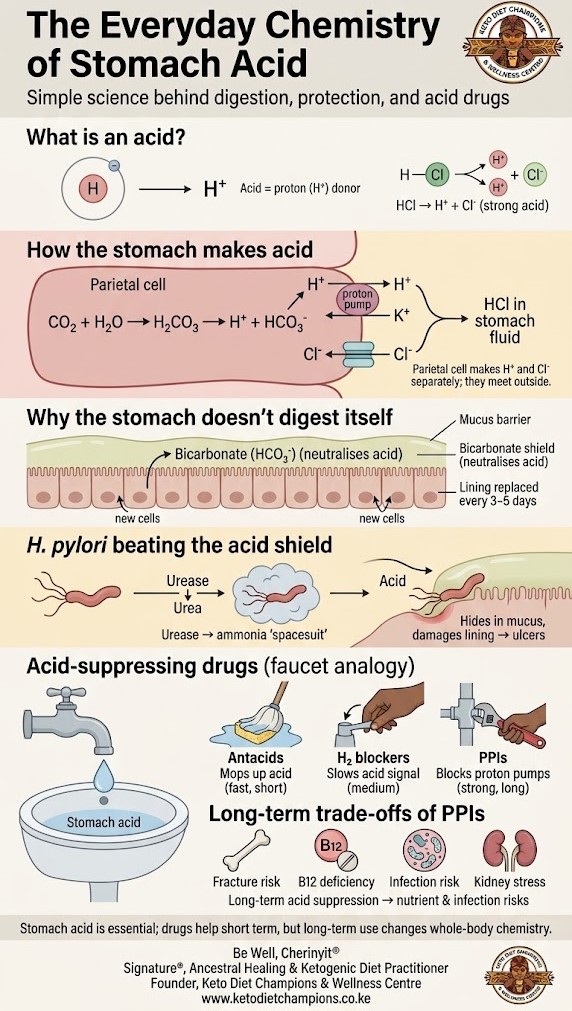
In chemistry, an acid is simply a substance that donates a proton. A proton, in this context, is just a hydrogen atom that has lost its electron—leaving behind a bare, positively charged hydrogen ion (H⁺). vectree
Hydrochloric acid (HCl) is the classic example. In its neutral form, hydrogen and chlorine share a pair of electrons. When HCl acts as an acid, chlorine keeps both electrons and hydrogen leaves as a bare proton. The leftover chlorine becomes a stable, negatively charged chloride ion (Cl⁻), which we call the conjugate base. Because HCl gives up its proton so readily, it's classified as a strong acid. edukatesingapore
*
How Your Body Makes Stomach Acid Without Floating HCl Molecules
Your stomach doesn't contain intact HCl molecules sloshing around. Instead, specialised parietal cells in your stomach lining pump out hydrogen protons (H⁺) and chloride ions (Cl⁻) separately. They only meet outside the cells, in the stomach fluid, where they combine to create hydrochloric acid. frontiersin
Here's the step-by-step:
Parietal cells pull water (H₂O) and carbon dioxide (CO₂) from your blood. An enzyme called carbonic anhydrase forces them to combine into carbonic acid (H₂CO₃), which then naturally splits into bicarbonate (HCO₃⁻) and hydrogen protons (H⁺). edukatesingapore
Your cells use a biological engine called the proton-potassium pump (H⁺/K⁺-ATPase). This pump burns cellular energy (ATP) to force hydrogen protons out into the stomach cavity against a massive concentration gradient—over a million-fold—while pulling potassium ions (K⁺) back in. frontiersin
Meanwhile, chloride ions—originally from the salt in your diet—are pulled from your blood and shot out through a separate channel to balance the positive protons. Once outside, H⁺ and Cl⁻ combine to form HCl in your stomach fluid. edukatesingapore
This system runs on demand. When you smell, think about, or swallow food, hormonal signals tell these proton pumps to go into high gear. Once food moves into your small intestine, your pancreas releases bicarbonate to neutralise the acidic liquid back into harmless water and carbon dioxide. Chloride is reabsorbed through your intestinal walls, and any excess is filtered out by your kidneys. edukatesingapore
*
Why Doesn't Stomach Acid Digest the Stomach Itself?
Stomach acid is strong enough to dissolve metal, yet your stomach—made of protein—doesn't digest itself. That's because your body uses a brilliant three-layered defence system: jove
1.Mucus barrier
Specialised cells secrete a thick, jelly-like mucus layer that physically blocks acid from touching the stomach tissue.
2.Bicarbonate shield
Those same cells pump bicarbonate directly into the bottom layer of the mucus. Any stray acid trying to burn through gets instantly neutralised into water and salt.
3.Rapid cell turnover
Even with these shields, the surface cells still take a beating. So your stomach lining completely replaces its entire inner surface layer every three to five days, shedding old cells and sealing microscopic gaps before acid can leak through. jove
When this system fails—often due to bacterial infection or overuse of certain painkillers—acid breaks through and forms a painful ulcer. ubiehealth
*
The One Bacterium That Beats the Acid Shield: Helicobacter pylori
Most bacteria can't survive raw stomach acid. But H. pylori has learned a genius two-step trick: jove
The bacterium produces an enzyme called urease, which grabs urea (a natural waste chemical in your stomach) and breaks it down into ammonia (NH₃) and carbon dioxide. Ammonia is a strong base, so it forms a literal cloud of neutralised liquid around the bacterium, protecting it from acid.
Protected by this ammonia cloud, H. pylori uses its spinning, tail-like flagella to swim rapidly through the acid pool until it reaches the thick mucus barrier. It burrows deep inside that safe, neutral mucus layer and attaches to the stomach wall.
Over time, its chemical byproducts and the inflammation it triggers damage the mucus, leaving the stomach wall exposed to its own acid—which is how it causes ulcers. jove
*
How Modern Acid-Suppressing Drugs Work (and Their Trade-Offs)
Think of your stomach acid like a leaking faucet. Modern medicine has developed three main types of drugs to deal with it: frontiersin
1. Antacids (e.g., Tums, Rennie)
2. H₂ Blockers (e.g., Famotidine)
3. Proton Pump Inhibitors (PPIs, e.g., Omeprazole)
*
The Hidden Costs of Long-Term Acid Suppression
PPIs are incredibly effective for short-term healing of severe acid reflux or ulcers. But shutting off your stomach acid for months or years comes with significant biological consequences. Remember, stomach acid has two vital jobs: absorbing nutrients and killing dangerous invaders. wipeoutreflux
Nutrient absorption problems
Without enough acid, your body struggles to:
Infection risk
Turning off your stomach's natural acid shield leaves you vulnerable to:
Rebound acid hypersecretion
If you try to stop taking PPIs cold turkey after long-term use, your stomach cells often panic and temporarily flood your system with a massive rebound wave of acid, causing intense heartburn. wipeoutreflux
*
The Bottom Line
Stomach acid isn't a design flaw or a mistake your body is making—it's a finely tuned, highly energetic chemical system essential for your survival. While blocking it with medication is a literal lifesaver for treating severe tissue damage or ulcers, doing so long-term changes your internal chemistry in ways that ripple across your entire body. frontiersin
*
Be Well,
Cherinyit®
Ancestral Healing & Ketogenic Diet Practitioner
Founder, Keto Diet Champions & Wellness Centre
Ready to Start?
Book a consultation today
Take the first step toward your health transformation with a KSh 300 consultation.
Book Now →