The Dead Water Myth: Why Boiled Water Won't Burn Fat
"Drink hot water to melt fat." Wrong. Fat loss is biochemical, not mechanical. I expose why boiled water is "dead," how the Bohr Effect links hydration to oxygen delivery, and the 4 ancestral pillars that kept our forebears hydrated—no supplements needed. Plus: my grandfather's salt lick story and why "how much water?" is the wrong question. Your cells need electrolytes and low insulin, not hot water.
Korir Cherinyit
Thursday, 27 August 2026
The Dead Water Myth: Why Boiled Water Won't Burn Fat (But Ancestral Hydration Will Transform Your Metabolism)
By Cherinyit
Wellness Coach & Founder, Keto Diet Champions & Wellness Centre
Published on www.ketodietchampions.co.ke
*
Introduction: The Hot Water Fat-Burning Lie
You've heard it from wellness influencers, traditional healers, and even well-meaning family members: "Drink hot water in the morning to melt away fat." The logic sounds simple—hot water melts fat in your kitchen, so it must melt fat in your body, right?
Wrong.
This is one of the most persistent—and physiologically impossible—myths in the wellness space. Fat metabolism is a biochemical process, not a mechanical plumbing issue. No amount of hot water can force a triglyceride to detach from a fat cell, nor can it force your mitochondria to undergo β-oxidation. Those processes require a low-insulin environment and an energy deficit—nothing more, nothing less.
In this deep dive, we'll expose:
Let's separate biochemistry from broscience.
*
My Grandfather's Story: The Salt Lick Water That Healed
My grandfather used to tell me stories of our ancestral home—stories that I didn't fully appreciate until I began understanding the science behind them.
He spoke of a time when someone in the village fell ill, or when an elder grew so weak they could barely rise from their mat. The young men would trek to the salt licks—natural mineral deposits where wildlife came to drink—and carry home water that had pooled in those mineral-rich hollows.
"We gave this water to the sick and the old," he told me, "and within hours, they regained energy. Their eyes brightened. Their hands stopped trembling. Some who had been bedridden began to walk again."
As a child, I thought this was folklore. But now, as a wellness coach who understands the biochemistry of electrolytes, I realize my grandfather was describing a masterclass in mineral repletion.
The Science Behind the Salt Lick
Natural salt licks are geological treasure troves. Research confirms they contain:
When my grandfather gave that salt lick water to a frail elder, he wasn't just giving them "salty water." He was delivering a complete electrolyte profile in bioavailable, ionic form—exactly what a depleted body needs to restore:
The lesson: Ancestral wisdom didn't need textbooks. They observed what worked—mineral-rich water restored vitality—and passed it down through generations.
Today, we've replaced salt lick water with boiled tap water, purified bottled water, and reverse osmosis systems—all stripped of the very minerals our cells depend on.
*
The "Dead Water" Concept: What Happens When We Boil Water?
When you boil water, you're not killing "life" in the biological sense—water (H₂O) is an inorganic solvent with no cellular life, enzymes, or active biological energy. But boiling does alter water's physical chemistry in ways that degrade its biological value.
1. Depletion of Dissolved Gases
Boiling aggressively drives out dissolved oxygen and carbon dioxide. This is why boiled water tastes "flat" compared to fresh spring water.
The science: Gas solubility is inversely proportional to temperature. As water approaches 100°C, dissolved oxygen (O₂) and carbon dioxide (CO₂) escape as bubbles. The result? Water that feels dull and lifeless on the palate—similar to how soda tastes after it's gone flat.
Why it matters: Dissolved oxygen contributes to the perceived "freshness" of water. While your body doesn't rely on drinking water for oxygen (you have lungs for that), the loss of dissolved gases is a marker of broader mineral changes.
2. Mineral Precipitation: The Scale Problem
In hard water areas (common across Kenya, including Nairobi), boiling triggers decomposition of calcium and magnesium bicarbonates:
Ca(HCO₃)₂ (aq) → CaCO₃ (s) + H₂O (l) + CO₂ (g)
Mg(HCO₃)₂ (aq) → MgCO₃ (s) + H₂O (l) + CO₂ (g)
That white, chalky scale at the bottom of your kettle? It's the calcium and magnesium that used to be bioavailable in the water. Boiling literally turns dissolved, biological electrolytes into solid rock, rendering the water demineralized.
Critical nuance: Boiling only removes temporary hardness (bicarbonates). Permanent hardness from calcium sulfate or magnesium chloride remains—but the overall mineral profile is still degraded.
3. Pathogen Eradication: The Safety Trade-Off
Let's be clear: boiling kills microorganisms, and in areas with uncertain water safety, this is non-negotiable. CDC guidelines recommend bringing water to a rolling boil for 1 minute to inactivate waterborne pathogens. But safety comes at a cost—mineral depletion and gas loss.
The solution: If you must boil for safety, re-mineralize afterward (more on this in the ancestral hydration section).
*
The Thermogenic Myth: Hot vs. Cold Water and Fat Loss
Wellness gurus often claim hot water "melts" fat. This ignores basic gastrointestinal anatomy. When you drink hot water, it travels down the esophagus and into the stomach, where it is rapidly cooled to the body's core temperature (approximately 37°C). It never physically interacts with subcutaneous or visceral adipose tissue.
The Thermodynamics Reality
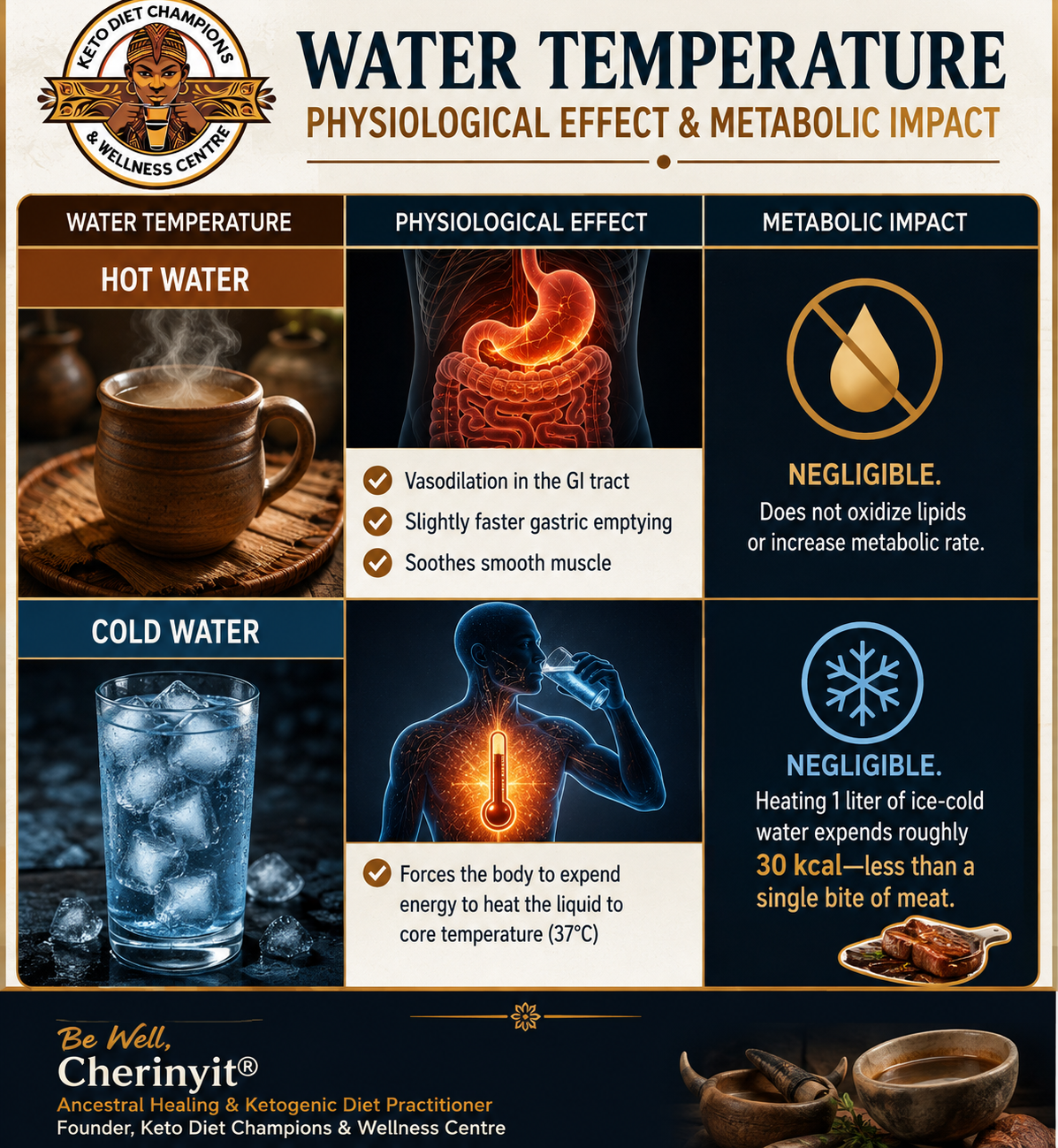
| Water Temperature | Physiological Effect | Metabolic Impact |
|---|---|---|
| Hot Water | Vasodilation in the GI tract; slightly faster gastric emptying; soothes smooth muscle | Negligible. Does not oxidize lipids or increase metabolic rate. |
| Cold Water | Forces the body to expend energy to heat the liquid to core temperature (37°C) | Negligible. Heating 1 liter of ice-cold water expends roughly 30 kcal—less than a single bite of meat. |
The verdict: In both cases, the metabolic impact is so minuscule that it's completely irrelevant to actual weight loss or fat adaptation.
Why the Confusion?
The recommendation largely stems from traditional practices (like Ayurveda), which observed that warm liquids can aid digestion. Warm water acts as a vasodilator, widening blood vessels in the digestive tract, which can momentarily aid in gastrointestinal motility and relieve constipation.
The conflation: Gurus mistake digestive relief for fat loss. Warm water may help you eliminate waste from the intestines, but it does not oxidize triglycerides from adipose tissue. These are entirely different physiological compartments.
*
Fat Loss is Chemical: The Reality of Lipolysis
To "burn" fat, the body must undergo two distinct chemical phases:
1. Lipolysis: Breaking Down Stored Fat
The breakdown of stored triglycerides into free fatty acids and glycerol requires the activation of an enzyme called Hormone-Sensitive Lipase (HSL). HSL is strictly regulated by hormones:
Key insight: If insulin is high (due to frequent carbohydrate consumption), lipolysis is essentially locked, regardless of how much hot water is consumed.
2. β-Oxidation: Burning Fat for Energy
Once released into the bloodstream, free fatty acids must be transported into the mitochondria of the cells. Here, they undergo β-oxidation to produce Acetyl-CoA, which enters the Krebs cycle to generate cellular energy (ATP).
The bottom line: No amount of hot water can force a triglyceride to detach from a fat cell, nor can it force a mitochondria to undergo β-oxidation. Those processes require a low-insulin environment and an energy deficit.
*
The Biochemical Impact of Demineralized Water on Your Body
Drinking demineralized, boiled water has a distinctly different impact on your cellular biology compared to mineral-rich spring water.
Cellular Hydration and Osmotic Balance
| Physiological Need | Natural Spring Water | Boiled & Cooled Water |
|---|---|---|
| Cellular Hydration | Contains the electrolytes necessary to maintain osmotic pressure, allowing water to easily enter cells | Hypotonic (lacks solutes). Can dilute blood plasma, forcing the body to work harder to maintain osmotic balance. |
| Enzymatic Function | Provides trace magnesium and zinc, which are mandatory co-factors for over 300 enzymatic reactions, including ATP (energy) production | Inert. Offers zero structural support for metabolic enzymes. |
| Bone & Tissue Health | Bicarbonates and calcium help buffer blood acidity and support osteoblast (bone-building) activity | The body must pull calcium and magnesium from its own reserves (bones/teeth) to buffer and process the mineral-depleted fluid. |
The Long-Term Health Risks
The World Health Organization (WHO) and multiple epidemiological studies have flagged concerns about long-term consumption of demineralized water:
WHO's stance: "Demineralized water has a definite adverse influence on the human organism." Long-term consumption of reverse osmosis (RO) or distilled water is not suitable without remineralization.
*
The Bohr Effect: How Water Quality Affects Oxygen Delivery
Here's where hydration meets metabolism in a way most people never consider.
What is the Bohr Effect?
The Bohr Effect describes hemoglobin's lower affinity for oxygen secondary to increases in the partial pressure of carbon dioxide (CO₂) and/or decreased blood pH. This lower affinity enhances the unloading of oxygen into tissues to meet the oxygen demand of the tissue.
In plain English: When your tissues are metabolically active (like exercising muscle), they produce CO₂ and hydrogen ions (H⁺), which lower pH. Hemoglobin senses this acidic environment and releases more oxygen exactly where it's needed most.
The Chemistry
Through the enzyme carbonic anhydrase, carbon dioxide and water are converted to carbonic acid (H₂CO₃), which dissociates into hydrogen ions (H⁺) and bicarbonate (HCO₃⁻):
CO₂ + H₂O ↔ H₂CO₃ ↔ H⁺ + HCO₃⁻
This release of hydrogen ions decreases pH, which stabilizes hemoglobin in the taut (T) form—the low-affinity state that releases oxygen to tissues.
Why This Matters for Hydration
Electrolyte balance—particularly magnesium and calcium—supports proper pH buffering and enzymatic function, including carbonic anhydrase activity. When you drink demineralized water:
For your clients: On a ketogenic diet, proper electrolyte support isn't just about preventing "keto flu"—it's about optimizing oxygen delivery to tissues for fat oxidation and ATP production.
*
Ancestral Hydration: The 4 Pillars of Optimal Hydration
Ancestral populations never relied on synthetic electrolyte packets or flavored sports drinks. Yet, they maintained cellular hydration and mineral balance through their immediate environment, traditional food matrices, and nose-to-tail dietary practices.
Pillar 1: Mineral-Rich Spring and Well Water
Before industrial water treatment and boiling became standard practices, humans drank directly from living springs, glacial runoff, and clean rivers. As this water filtered through layers of earth, limestone, and bedrock, it naturally dissolved essential minerals like magnesium, calcium, potassium, and bicarbonate in their fully bioavailable, ionic states.
Indigenous wisdom: Across Africa, traditional communities managed water sources through sophisticated knowledge systems:
Modern application:
Pillar 2: Nose-to-Tail Animal Consumption
Animals store electrolytes in their fluids and structural tissues. Ancestral diets utilized the whole animal, unlocking rich electrolyte sources that modern muscle-meat-only diets miss:
| Ancestral Component | Electrolyte Profile | Modern Gap |
|---|---|---|
| Animal Blood (traditional soups, blood-milk mixtures) |
Natural saline: Na⁺, K⁺, Cl⁻, iron | Completely absent in modern diets |
| Bone Broths & Joint Soups (slow-cooked bones, cartilage, connective tissue) |
Calcium, magnesium, phosphorus, collagen, gelatin | Replaced with bouillon cubes (pure NaCl + MSG) |
| Organ Meats (liver, kidney, heart, spleen) |
Potassium-dense, plus B12, copper, selenium, CoQ10 | Muscle meat only = electrolyte-poor |
| Fermented Dairy (mürsik, traditional Kalenjin yogurt) |
Potassium, calcium, probiotics, vitamin K2 | Pasteurized, homogenized milk = reduced mineral bioavailability |
Kenyan traditional foods:
Pillar 3: "Cellular Water" from Food
Ancestors consumed water bound inside biological cell structures—what scientists call structured or gel water.
Why it matters: Food-bound water arrives pre-balanced with electrolytes, preventing the hypotonic load of plain water that forces the body to redistribute minerals.
Pillar 4: Natural Rock and Sea Salts
Whenever accessible, ancient cultures harvested salt from dried lake beds, rock deposits, or evaporated seawater. Unlike modern refined table salt (which is stripped down to pure NaCl with anti-caking agents), unrefined natural salts contain dozens of trace elements that support kidney function and fluid regulation.
The nuance:
Iodine caveat: Most unrefined salts are not iodized. Ensure adequate iodine from seafood, dairy, or occasional iodized salt if whole-food sources are limited.
*
What We Can Learn & Apply Today
| Ancestral Practice | Modern Equivalent / Actionable Step |
|---|---|
| Drinking living spring water | Source natural spring water, or re-mineralize filtered water with a pinch of unrefined sea salt or trace mineral drops. |
| Cooking bone & joint broth | Regularly simmer marrow bones, joints, and connective tissue to create a warm, mineral-dense broth instead of drinking plain hot water. |
| Consuming whole foods | Prioritize electrolyte-rich whole foods like organ meats, bone broth, avocado, and unrefined salt rather than sugary electrolyte beverages. |
| Eating unrefined salt | Replace bleached table salt with mineral-rich grey sea salt or unrefined rock salt. |
*
My Personal Insight: "Cherinyit, How Much Water Should I Drink?"
At Keto Diet Champions & Wellness Centre, this is the question I get asked most often. And my answer might surprise you:
"Listen to your body. Drink when you're thirsty."
Here's why: Hydration needs are multivariate. They depend on:
The myth: "Drink 8 glasses a day" or "3 liters minimum."
The truth: Your thirst mechanism is a finely tuned biological sensor. When you're eating a nutrient-dense, ancestral diet with adequate salt, your body will tell you when to drink.
For keto clients: In the first 2–4 weeks of carbohydrate restriction, you'll lose significant water weight (glycogen depletion). This is when you need to be proactive with electrolytes (sodium, potassium, magnesium) and drink to thirst—often more than usual. After adaptation, thirst becomes a reliable guide again.
Practical tip: Keep water accessible. If you're thirsty, drink. If your urine is dark yellow, drink more. If you're experiencing headaches, fatigue, or cramps on keto, it's likely electrolytes—not just water.
*
Conclusion: Return to Ancestral Wisdom
The hot water fat-burning myth persists because it's simple, intuitive, and sounds plausible. But human physiology doesn't work that way. Fat loss is hormonal. Hydration is mineral-dependent. And water quality matters far more than water temperature.
My grandfather's generation didn't have biochemistry textbooks. They had observation, tradition, and the wisdom to notice what worked: mineral-rich water restored vitality.
Today, we have the science to explain why. We also have the tools to reclaim ancestral hydration practices in a modern context:
Your cells don't need hot water. They need electrolytes, minerals, and a low-insulin environment. Give them that, and watch your metabolism transform.
*
Be Well,
Cherinyit®
Ancestral Healing & Ketogenic Diet Practitioner
Keto Diet Champions & Wellness Centre
@KDC_Wellness
*
Disclaimer: This blog post is for educational and informational purposes only and is not medical advice. Always consult your doctor or qualified health provider regarding any medical condition or treatment.
Ready to Start?
Book a consultation today
Take the first step toward your health transformation with a KSh 300 consultation.
Book Now →