Understanding Diabetes Type 2
Many of my clients come to me on multiple medications—insulin, metformin, blood pressure drugs—feeling trapped in a cycle of “more drugs, more symptoms, more despair.”
Korir Cherinyit
Wednesday, 15 July 2026
From Internal Starvation to Cellular Overflow: A Compassionate, Scientific Shift in Understanding Type 2 Diabetes
A Story of Misunderstanding
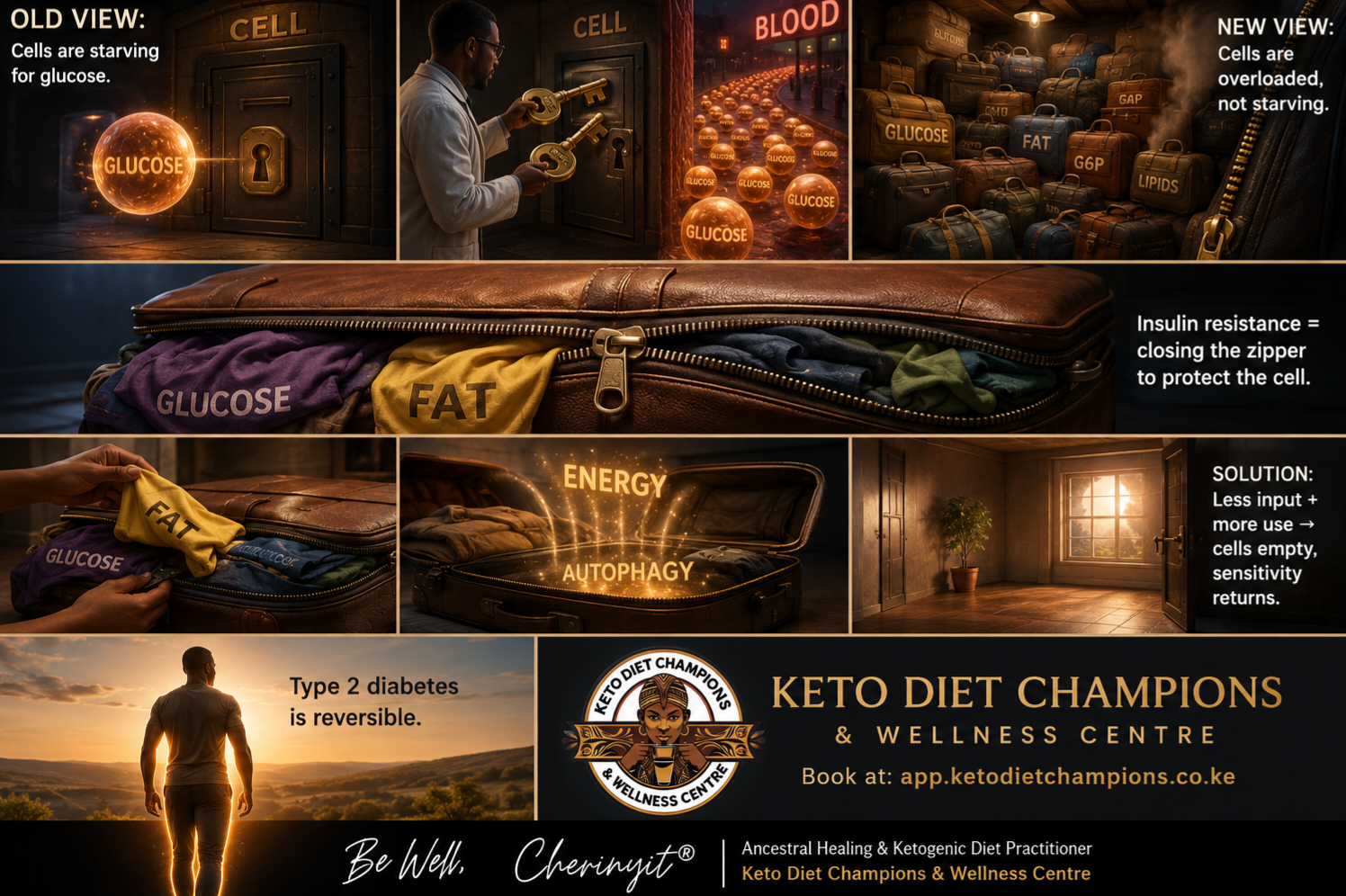
For decades, patients, families, and even many healthcare providers have been taught that in type 2 diabetes, the cells are “starving” for glucose because insulin cannot open the door. High blood sugar is seen as glucose stuck outside, and the solution is to push more glucose in—usually with more insulin.
But this view is not only scientifically flawed; it is emotionally damaging. It frames the patient as someone whose body is failing to feed itself, rather than someone whose body is struggling to handle too much.
Today, we will walk through the science, the logic, and the empathy behind a new paradigm: from internal starvation to cellular overload.
*
The Old Story: “Cell Starvation” in Type 2 Diabetes
In the classic “lock and key” teaching:
This model fits neatly with type 1 diabetes, where there is little or no insulin, and cells truly cannot take up glucose. But in type 2 diabetes:
If the cells were truly “starving” of glucose, why are they so full of fat and energy stores? This is the first clue that the “cell starvation” model does not fit the reality of type 2 diabetes.
*
The New Story: The Overflow Paradigm
Jason Fung and other metabolic scientists propose a different view: the overflow paradigm.
In type 2 diabetes:
The cell is not starving. It is overloaded.
The Suitcase Analogy
Imagine a suitcase with limited capacity:
Insulin resistance is your body’s way of closing the zipper: it says, “I cannot take any more.” The clothes that cannot fit are left outside—the high blood glucose you see on lab tests.
The solution is not to force the zipper wider (more insulin). It is to:
This is exactly what lowering carbohydrates and incorporating fasting do for the body.
*
Why the “Cell Starvation” Model Is Scientifically Wrong
1. The Phenotype: Overfull, Not Empty
In type 2 diabetes, patients are not thin and malnourished; they are often overweight. Their organs are fatty, not empty. Their muscles and liver show signs of lipotoxicity and glucotoxicity.
This pattern is consistent with metabolic overload, not starvation.
2. The Biochemistry: Overloaded Metabolites
Even though free intracellular glucose may be low (because it’s rapidly converted to G6P), the cell is not empty:
These metabolites interfere with insulin signaling, damage mitochondria, and trigger inflammation. The cell is not starving; it is metabolically clogged.
3. The Signaling: Downregulation, Not Simple Blockage
In insulin resistance:
This is not a broken lock; it is a deliberate downregulation to reduce signaling in an overstimulated system. The cell is protecting itself from too much input, not from too little.
*
Why This Shift Matters for Patients
1. It Removes Blame
When patients hear “your cells are starving,” they may feel their body is failing to feed itself and that they need more fuel. But when they understand that their body is overloaded and their cells are protecting themselves, the narrative shifts from “I am broken” to “My body is trying to protect me.”
2. It Makes Treatment Logical
In the starvation model, the solution is to push more glucose in. In the overflow model, the solution is to:
This empties the cells, restores sensitivity, and lowers both insulin and glucose. This aligns with the ancestral-keto framework we use at Keto Diet Champions.
3. It Brings Hope for Reversal
If type 2 diabetes is a disease of overflow, then the overflow can be reduced, the cells can be emptied, and the system can regain sensitivity. Bariatric surgery, low-carb diets, and fasting have all shown that high blood glucose can drop dramatically, insulin requirements can fall, and some patients can even discontinue medications. Type 2 diabetes is not a lifetime sentence; it is a metabolic state that can change.
*
A Practical Insight from My Coaching Practice
As a wellness coach at Keto Diet Champions & Wellness Centre, I have worked with many clients living with type 2 diabetes, obesity, and metabolic syndrome. One pattern I see repeatedly is this:
Many of my clients come to me on multiple medications—insulin, metformin, blood pressure drugs—feeling trapped in a cycle of “more drugs, more symptoms, more despair.”
Through an ancestral-keto approach combined with structured fasting and movement, and always in collaboration with their doctors, we reduce their glucose and insulin load. Over time, their bodies begin to empty the overload. Their insulin sensitivity improves. Their blood sugars stabilize. And in many cases, under medical supervision, their medications are reduced or even discontinued.
This is not about rejecting medicine. It is about using nutrition and fasting as metabolic medicine, working with doctors, not against them. I have seen people who once felt cursed by their diagnosis walk away from their condition with fewer pills, clearer energy, and a renewed sense of hope.
That is the power of understanding diabetes as overflow, not starvation.
*
A Compassionate Message to Patients
For every person living with type 2 diabetes, obesity, or metabolic syndrome:
Your cells are overloaded. They are trying to protect you from too much glucose and too much insulin. The high blood sugar is not proof of starvation; it is proof of overflow.
This means:
By:
You are giving your cells a chance to breathe again.
*
Your Next Step
If you are ready to move from managing symptoms to addressing the root cause of your metabolic health, I invite you to book a personalized coaching session with me.
We will:
Book now at: app.ketodietchampions.co.ke
*
Disclaimer:
This content is for educational purposes only and does not replace professional medical advice, diagnosis, or treatment.
*
Be Well,
Cherinyit®
Ancestral Healing & Ketogenic Diet Practitioner
Keto Diet Champions & Wellness Centre
App: app.ketodietchampions.co.ke | Web: www.ketodietchampions.co.ke
Locations: Eldoret & Nairobi, Kenya
Ready to Start?
Book a consultation today
Take the first step toward your health transformation with a KSh 300 consultation.
Book Now →